
A few years ago, simply adding a webchat to your website felt like a big step towards digital transformation. It could answer common questions, capture contact information, and remain available long after your sales team had logged off for the day. For many businesses, that was enough.
Today, customer expectations have changed.
People no longer want to fill out forms or wait for an email response. They expect conversations that feel natural, immediate, and helpful. That shift has given rise to a new debate: Voice AI vs AI chatbot. While both are forms of conversational AI, they solve very different problems. Understanding that difference is becoming increasingly important for businesses looking to improve lead generation and customer engagement.
Explore Skalix AI's conversational AI solutions
Quick Comparison: Voice AI vs Chatbot for Sales Outreach & Inbound Sales
If you are comparing Voice AI and chatbots to drive revenue, here is the direct breakdown:
- Voice AI vs Chatbot for Sales Outreach: Which converts better? Voice AI converts 3x to 5x higher than text chatbots on outbound and inbound sales outreach. Sales outreach requires immediate rapport, tone modulation, and live objection handling. While web chatbots require passive visitor engagement, Voice AI calls interested prospects within 60 seconds and secures calendar bookings on the spot.
- How to choose between an AI chatbot and a voice agent for inbound sales: Choose an AI Chatbot if your product is low-ticket, self-serve, or documentation-heavy, and your visitors prefer quiet browsing. Choose a Conversational AI Voice Agent if your average deal size is high, qualification involves multiple discovery questions, or rapid phone contact directly dictates your close rates.
- Voice AI vs Chatbot for Appointment Scheduling: Voice AI consistently achieves higher meeting show-up rates because verbal confirmation creates personal commitment, answers instant scheduling objections, and syncs calendar slots during natural dialogue.
- Voice AI vs Traditional Conversational AI: Traditional conversational AI refers to scripted, menu-based bots or asynchronous text tools. Modern Voice AI is an autonomous, speech-first intelligence layer capable of real-time low latency (<800ms), conversational interruption, and natural human prosody.
Voice AI vs Chatbot: Understanding the Difference
Although Voice AI and chatbots are often grouped together, they create very different customer experiences.
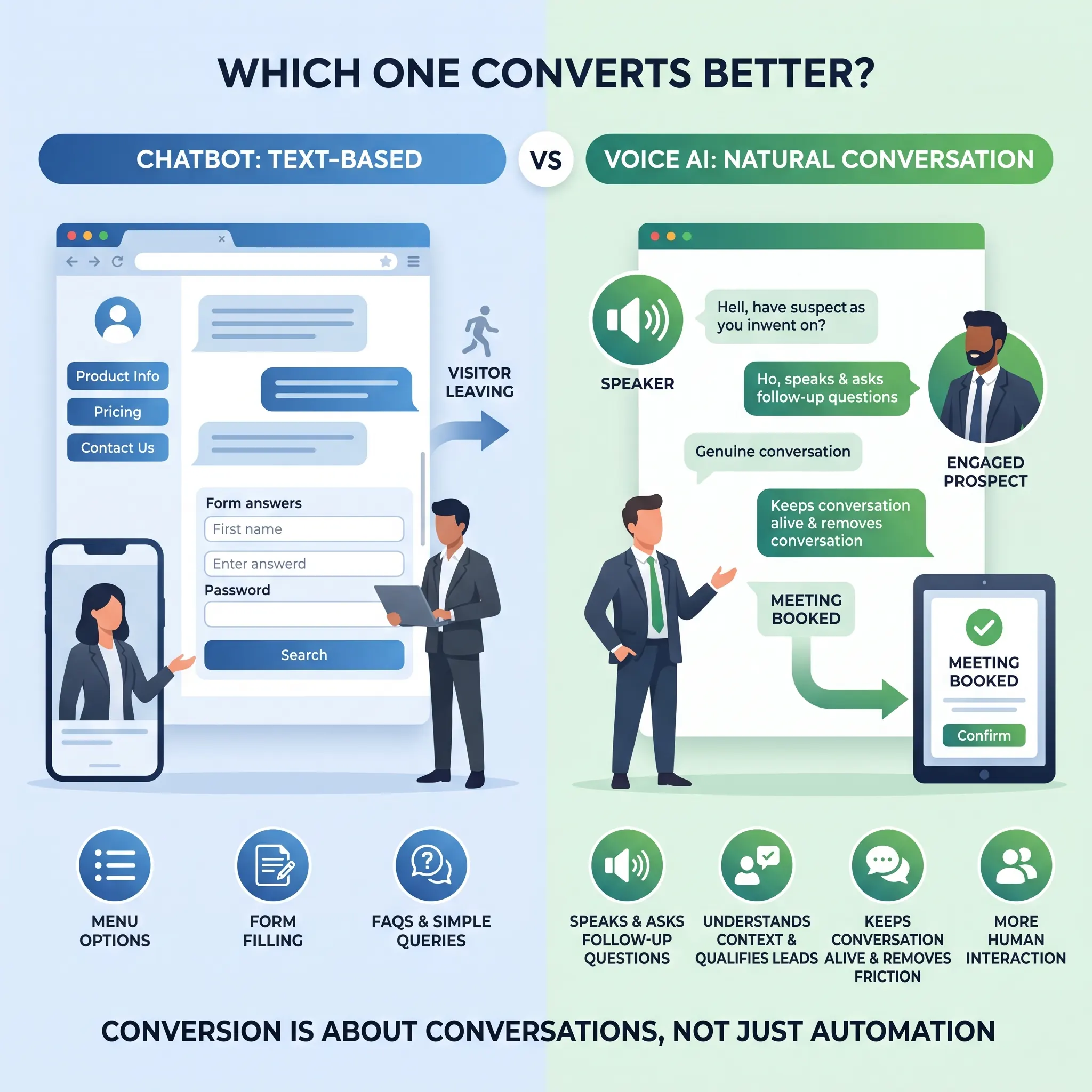
A chatbot is designed around text. It works best when customers already know what they are looking for and are comfortable typing their questions. Whether it's checking an order status, downloading a brochure, or finding pricing information, chatbots excel at handling structured interactions quickly and efficiently.
Voice AI, on the other hand, is built around conversation. Instead of waiting for someone to type a response, it speaks naturally, asks follow-up questions, understands context, and guides the discussion just as a human representative would. The interaction feels less like filling out a support form and more like talking to someone who genuinely wants to help.
That difference may seem subtle, but it has a significant impact on conversions.
Learn how AI voice agents for lead qualification work
Imagine a prospect visits your website after office hours. They're interested, but they're also evaluating three other vendors.
A traditional chatbot greets them with a menu of options. They click through a few responses, perhaps leave their email address, and move on.
Now imagine the same visitor being greeted by an AI voice assistant that says, "Hi! I noticed you're exploring our pricing page. Can I quickly understand what you're trying to solve?"
Instead of navigating menus, the visitor starts talking. The AI asks intelligent follow-up questions, qualifies the lead, answers objections, and books a meeting before the prospect ever leaves the website.
That's the real strength of AI voice agents for lead qualification. They don't simply collect information; they keep the conversation alive. By removing friction and creating a more human interaction, businesses are finding that prospects stay engaged for longer and are far more likely to take the next step.
Conversion Isn't About Automation. It's About Conversations.
Many companies assume automation alone increases conversions. In reality, automation only works when it makes the customer experience easier.
This is where Voice AI has an advantage.
Buying decisions are rarely linear. Prospects hesitate. They ask unexpected questions. Sometimes they need reassurance before they commit. These moments are difficult for rule-based chatbots because conversations often fall outside predefined workflows.
Voice AI adapts naturally. It understands intent, remembers context, and responds conversationally instead of simply matching keywords. Rather than replacing human sales teams, it prepares them by qualifying prospects before a salesperson even joins the conversation.
That's also why businesses are beginning to adopt an autonomous sales agent for B2B environments. These AI agents can engage inbound leads, qualify opportunities, schedule meetings, and even nurture prospects automatically. Sales representatives then spend their time where they create the most value—building trust, negotiating complex deals, and closing business.
See how Skalix helps B2B teams scale their sales conversations
Does That Mean Chatbots Are Obsolete?
Not at all.
Chatbots continue to be excellent for handling repetitive tasks such as FAQs, password resets, appointment confirmations, or order tracking. They're simple, familiar, and cost-effective.
The better question isn't Voice AI vs chatbot.
It's where should each technology be used?
If the objective is to provide information, a chatbot may be all you need.
If the objective is to qualify leads, engage prospects, and move conversations towards revenue, Voice AI offers a much richer experience.
Many organisations are now combining both technologies. A chatbot manages straightforward requests, while a GTM AI agent or Voice AI takes over high-intent conversations where personalised engagement matters most.
The Future of Customer Conversations
As AI continues to evolve, businesses will increasingly compete on customer experience rather than response speed.
Customers don't remember whether they interacted with a chatbot or a Voice AI system. They remember whether their problem was understood and whether someone helped them reach the right decision.
That's why the future isn't about replacing humans with AI. It's about allowing AI to handle repetitive work while people focus on empathy, judgement, negotiation, and relationship building.
The companies that embrace this balance will almost certainly outperform those that treat AI as nothing more than another automation tool.
If you're evaluating conversational AI for your business, start by asking a simple question:
Are you trying to answer questions—or are you trying to create conversations that convert?
FAQs
1. Voice AI vs chatbot: Which is better for lead generation?
For businesses focused on lead generation and qualification, Voice AI generally delivers better results because it enables natural conversations, asks follow-up questions, and keeps prospects engaged throughout the buying journey.
2. Voice AI vs chatbot: Can businesses use both together?
Yes. Many organisations use chatbots for simple support requests while using Voice AI for sales conversations, appointment booking, and lead qualification. The two technologies complement each other rather than compete.
3. Voice AI vs chatbot: Which is better for B2B sales?
For B2B businesses with longer and more consultative sales cycles, Voice AI often performs better because it can qualify prospects, understand buying intent, and act as an autonomous sales agent before handing conversations over to the sales team.
4. Voice AI vs chatbot for sales outreach: Which converts better?
Voice AI converts significantly better for sales outreach. Phone calls engage the prospect's full attention, allowing the AI to answer complex objections dynamically and book qualified meetings on the spot, whereas cold or warm text messages are frequently deferred or ignored.
5. How do I choose between an AI chatbot and a conversational AI voice agent for inbound sales?
Base the decision on buyer journey complexity. If your prospects have simple questions before purchasing online, a text chatbot is sufficient. If your inbound leads submit high-intent forms that need instant qualification (<60s call back) and calendar booking, a conversational AI voice agent delivers substantially higher conversion rates.
6. What's the difference between voice AI and traditional conversational AI?
Traditional conversational AI typically refers to text-driven chatbots, decision trees, or legacy IVR menus that match rigid keywords. Voice AI is a generative, speech-to-speech platform with natural conversational flow, context memory, real-time interruptions, and human-like inflection.