
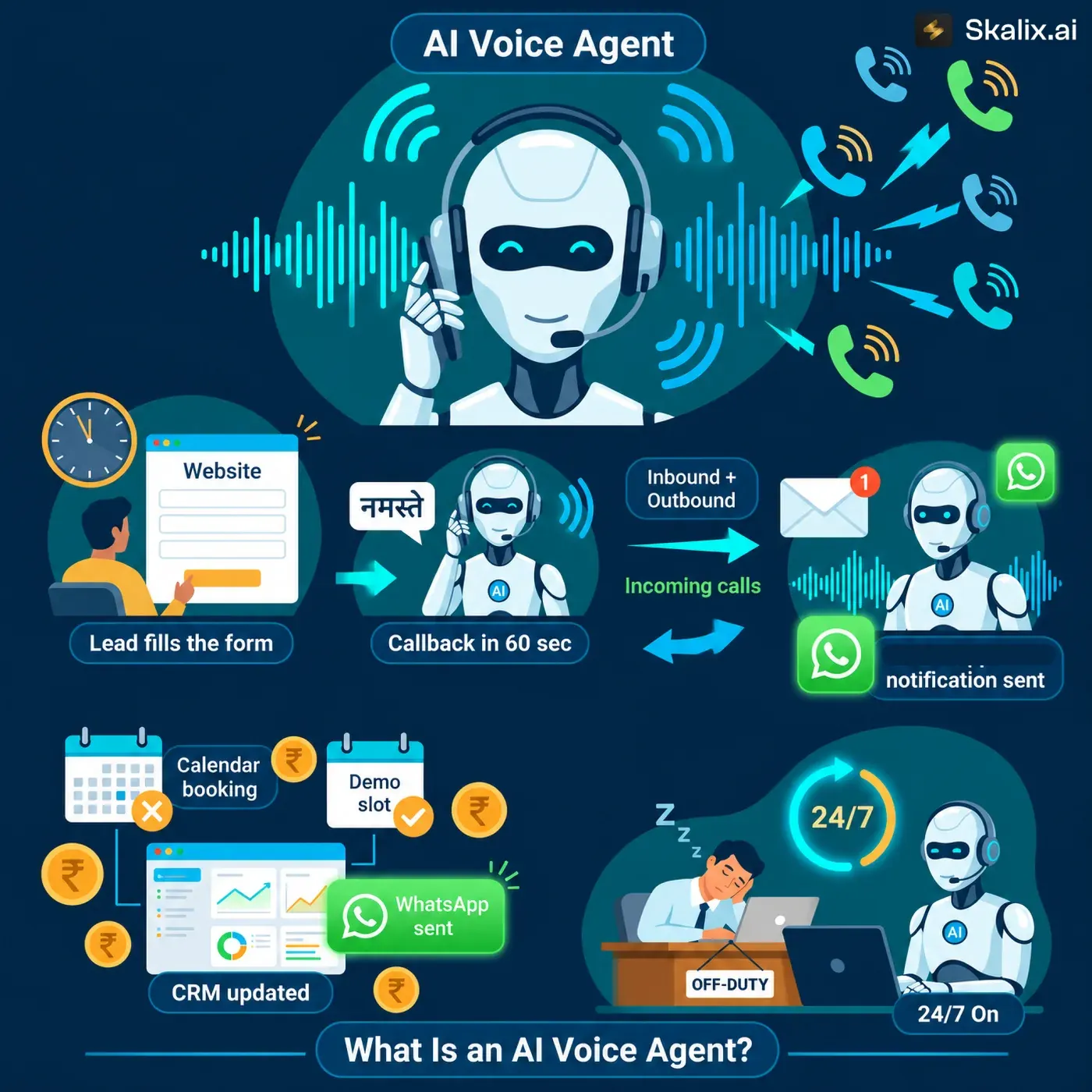
An AI voice agent is software that makes and answers phone calls on its own. It speaks in a natural, human-sounding voice, understands what the person on the other end is saying, and finishes a real task- qualifying a lead, booking a slot, confirming an order- without anyone sitting on the line. In plain terms, it's a computer that can hold a phone conversation.
For an Indian business, that usually shows up in one very specific way. A lead fills a form on your website at 9:47 at night. Within about a minute, your phone system calls them back, greets them in Hindi, asks a few questions, figures out whether they're serious, books them a slot, and updates your CRM- all before a human telecaller would have even seen the enquiry the next morning. That's the whole promise, and the rest of this guide unpacks how it actually works. Much of what follows is drawn from how teams build these systems on platforms like Skalix, an AI voice and chat platform built for Indian businesses, so the examples stay grounded in Indian call flows rather than Silicon Valley demos. And the timing isn't accidental: The conversational AI market in India is expected to reach a projected revenue of US$ 3,736.6 million by 2033. A compound annual growth rate of 26.4% is expected of India conversational ai market from 2026 to 2033. (Grand View Research).
What is an AI voice agent?
An AI voice agent is the full package: a system that can both speak and listen over a phone call and then act on what it hears. Think of it as three capabilities stitched together. It converts speech to text so it understands you, runs that through a language model so it can reason about what to say next, and converts its reply back into speech so it sounds like a person. Wrap all of that around a real phone line and a connection to your CRM or calendar, and you have a voice AI agent that can run an entire conversation end to end.
The distinction worth holding on to is this: a voice agent doesn't just talk. It does. Talking is the easy part now- the models are good, the voices are warm, the Hindi is convincing. The value is in the action at the end. Booking the demo. Confirming the delivery address. Flagging the angry customer for a human. A calling AI that only chats but never completes a task is a toy; an AI voice agent that updates your pipeline while you sleep is a tool.
What is a voice bot?
People use "voice bot" and "AI voice agent" almost interchangeably, and that's mostly fine. If there's a shade of difference, it's this. "Voice bot" is the older, broader term- it covers everything from the rigid "Press 1 for sales, press 2 for support" IVR menus you've suffered through, right up to today's conversational systems. An AI voice agent is the modern, intelligent end of that spectrum.
The old voice bot followed a rigid script and fell apart the moment you said something it didn't expect. Say "actually, can you just tell me the price?" to a 2015-era bot and it would loop you back to the main menu. A modern voice bot- a genuine AI one, simply answers the price question and carries on, because it understands intent rather than matching keywords. So when you see "voice bot" today, assume people mean the smart kind unless the context is obviously an old phone tree.
What is AI calling?
AI calling is the activity, not the thing. It's what happens when you point an AI voice agent at a list of numbers (outbound) or at your incoming helpline (inbound) and let it run the conversations. Outbound AI calling is the one most Indian businesses get excited about first, because it attacks the most painful, most repetitive job on the floor: dialling.
Here's the shift. A human telecaller dials, waits, gets a busy tone, dials again, reaches voicemail, dials again, finally connects- and burns half their day on the mechanics of calling rather than the talking. AI calling collapses all of that. The system can place hundreds of calls in parallel, never gets bored on the fiftieth one, never sounds flat at 6 p.m., and never forgets to log the outcome. Whether you call it ai calling, an ai calling agent, or just "the bot that rings our leads," the underlying idea is the same: let software carry the dialling-and-qualifying load so your people spend their hours only on the conversations that genuinely need a human.
Types of AI voice bot
Not every AI voice bot does the same job, and knowing the four common shapes helps you figure out what you actually need.
The first is the inbound answering agent- it picks up when customers call you, so nobody hits a busy tone or waits on hold at 11 p.m. A clinic using one never misses an appointment request again. The second is the outbound lead-qualification agent, the workhorse for sales teams: it calls fresh leads, asks the qualifying questions, and books the hot ones. The third is the reminder and confirmation agent- it rings to confirm a delivery, a site visit, an EMI date, a doctor's appointment- quiet, unglamorous, and brilliant at cutting no-shows. And the fourth is the cold-calling agent, which works a cold list to open doors; it's the most debated of the four, and we'll come to whether it actually works in a moment.
Most Indian businesses start with just one of these- usually inbound answering or outbound lead qualification- prove the value, and expand from there. You don't have to boil the ocean on day one.
How AI cold calling works: one real call flow
The clearest way to understand all of this is to follow a single call, start to finish. So here's a real-world flow for a mid-sized real estate team in, say, Pune.
It's 9:47 p.m. A prospect named Rohit, scrolling Instagram, taps an ad and fills a two-field form- name and number- asking about 2BHK flats. In the old world, that lead sits in a spreadsheet until a telecaller gets to it around 11 a.m. the next day, by which point Rohit has filled three competitors' forms too and taken a call from whoever rang first.
In the new world, the form submission instantly pings the AI voice calling agent. Within about 60 seconds, Rohit's phone rings. He answers, a little wary. "Namaste Rohit ji, Skyline Developers se baat kar rahe hain- aapne abhi 2BHK ke baare mein poocha tha, main do minute mein detail de doon?" The voice is calm and human; Rohit relaxes and says haan, go on.
Over the next ninety seconds the agent does real work. It asks his budget, whether he wants ready-to-move or under-construction, which area he prefers, and when he's looking to buy. Rohit answers in a mix of Hindi and English, as most of us do, and the agent keeps up without blinking. That language choice isn't a nicety- it's conversion. A KPMG-Google study found that 88% of Indian-language internet users are more likely to respond to outreach in their own language than in English. The agent figures out that Rohit has a genuine budget and a three-month timeline- a hot lead, not a tyre-kicker. So it offers two site-visit slots for the weekend, Rohit picks Saturday 11 a.m., and the agent confirms it.
The moment the call ends, three things happen automatically. The CRM gets a new qualified lead with budget, preference and timeline filled in. Saturday's slot lands on the sales manager's calendar. And a WhatsApp confirmation with the address and a map pin goes to Rohit. No human touched any of it. A salesperson walks in Monday to a booked, qualified visit instead of a cold spreadsheet- and that is how AI cold calling, done well, actually works.
Cold calling a fully cold list (people who never raised their hand) is harder and more regulated- more on that in the FAQ- but the speed-to-lead version above is where the real, immediate money is for most Indian businesses. The data backs this up bluntly. Harvard Business Review found the average company takes roughly 42 hours to respond. An AI voice agent that calls back in 60 seconds wins that race by default.
AI calling vs a telecaller: the cost per call
This is the comparison every founder runs in their head, so let's do it honestly- with the caveat that these are illustrative figures; your real numbers depend on volumes, language and vendor.
A single human telecaller in India typically costs somewhere around ₹18,000–₹30,000 a month once you add salary, incentives, a seat, a system and supervision. On a good day they make perhaps 80–120 dials and hold a few dozen real conversations. They work one shift, need breaks, take leave, and quality drifts by evening. Hiring, training and attrition quietly add to the bill all year.
An AI calling agent flips the cost structure from per-person to per-minute. You pay for talk-time, often a few rupees a minute, with no salary, no attrition, no night-shift premium. It runs 24×7, places many calls at once, and sounds exactly as fresh on call five hundred as on call one. For spiky, repetitive, high-volume work- the midnight lead, the delivery confirmation, the festival-season rush- the maths usually lands firmly in AI's favour.
The honest nuance: this is not about firing your telecallers. It's about aiming them better. Let the AI handle the grind of first-touch dialling and qualification, and let your humans spend their day only on the warm, high-intent conversations where trust and negotiation decide the deal. The team that pairs the two almost always beats the team that clings to either one alone.
How to make an AI calling agent?
"Making" an AI calling agent is less about code than most people fear. At its simplest, you're assembling four building blocks: a phone number and calling line, a speech engine that can speak and understand your language, a brain (a language model with your instructions and knowledge), and a connection to wherever the outcome needs to go- your CRM, calendar or WhatsApp.
You have three realistic routes. You can build it fully in-house, stitching together telephony, speech and LLM APIs yourself- powerful, but slow and engineering-heavy, and rarely worth it unless voice is your core product. You can use a horizontal global platform, which gets you started fast but often stumbles on Indian numbers, Hinglish and local compliance. Or you can use an India-first platform that already handles the phone lines, the Hindi and regional voices, the Hinglish code-switching, and the DLT/TRAI side of things- so you configure rather than build. For almost every Indian SME, the third route is the sensible one.
How to build an AI calling agent?
If you go the configure-not-code route, building a working agent is genuinely a short project, and it follows a simple arc.
Start with one job, not ten- pick the single most painful call you make (usually "call new leads fast and qualify them"). Then write the conversation the way you'd brief a sharp new hire: the opening line, the three or four questions that actually matter, how to handle the common objections, and exactly what counts as a "qualified" outcome. Next, give the agent your knowledge- your prices, your areas, your slots- so it answers from facts, not guesses. Connect the ending to your systems so a good call auto-books and auto-logs. Then test it on yourself and your team ruthlessly, in Hindi and English, trying to trip it up, until it stops tripping. Finally, point it at a small batch of real leads, read the transcripts, fix what's clumsy, and only then scale the volume.
The teams that succeed treat the agent like a new team member who improves every week with coaching- not a switch you flip once and forget. Review the calls, tune the script, and it gets sharper fast.
AI voice agents have moved, in about two years, from a novelty to a normal part of how Indian businesses handle their phones- the lead qualification, the reminders, the after-hours cover. The technology is ready; the real question now is simply which call you'll hand over first.
Frequently asked questions
How to create an AI calling agent?
Creating an AI calling agent comes down to four pieces: a calling line and number, a speech engine for your language, a language model with your instructions and knowledge, and a link to your CRM or calendar. Most Indian businesses don't build these from scratch- they configure them on an India-first AI voice agent platform that already handles telephony, Hindi/Hinglish and TRAI/DLT compliance, so you can be live in days rather than months.
Give a Voice bot example.
A common voice bot example is a real estate team's lead-qualification agent: a prospect fills a form, the voice bot calls within a minute, asks budget, location and timeline in Hindi, books a site visit, and updates the CRM. Other everyday examples include clinics confirming appointments, lenders sending EMI reminders, and e-commerce sellers verifying COD orders- all handled by an AI voice agent instead of a human telecaller.
Is AI calling people?
Yes, AI calling is already happening at scale. When you get a call that confirms a delivery, reminds you of an appointment, or follows up on an enquiry you just made, there's a growing chance you're speaking to an AI voice agent rather than a person. Good ones are transparent about being automated, and the better they get, the more natural and genuinely helpful those calls become.
Can AI do cold calling?
AI can do cold calling, and it's extremely effective at the "warm-cold" version — calling leads who just raised their hand (a form fill, an ad click) within seconds, in their language. This matters because speed decides the deal: the MIT / InsideSales.com study found you're 21 times more likely to qualify a lead contacted in five minutes versus thirty. Calling a fully cold list of people who never opted in is technically possible but riskier: it works less well and runs into India's DLT/TRAI consent rules, so most businesses use AI calling for fast follow-up on inbound leads rather than blind cold outreach.
How to create a voice bot?
To create a voice bot, decide on one clear job, write the conversation (opening line, key questions, objection handling, and what a successful outcome looks like), feed it your real information so it answers accurately, and connect the result to your CRM, calendar or WhatsApp. Test it hard in Hindi and English before going live. Using a ready AI voice platform makes this a configure-and-launch task rather than a coding project.