
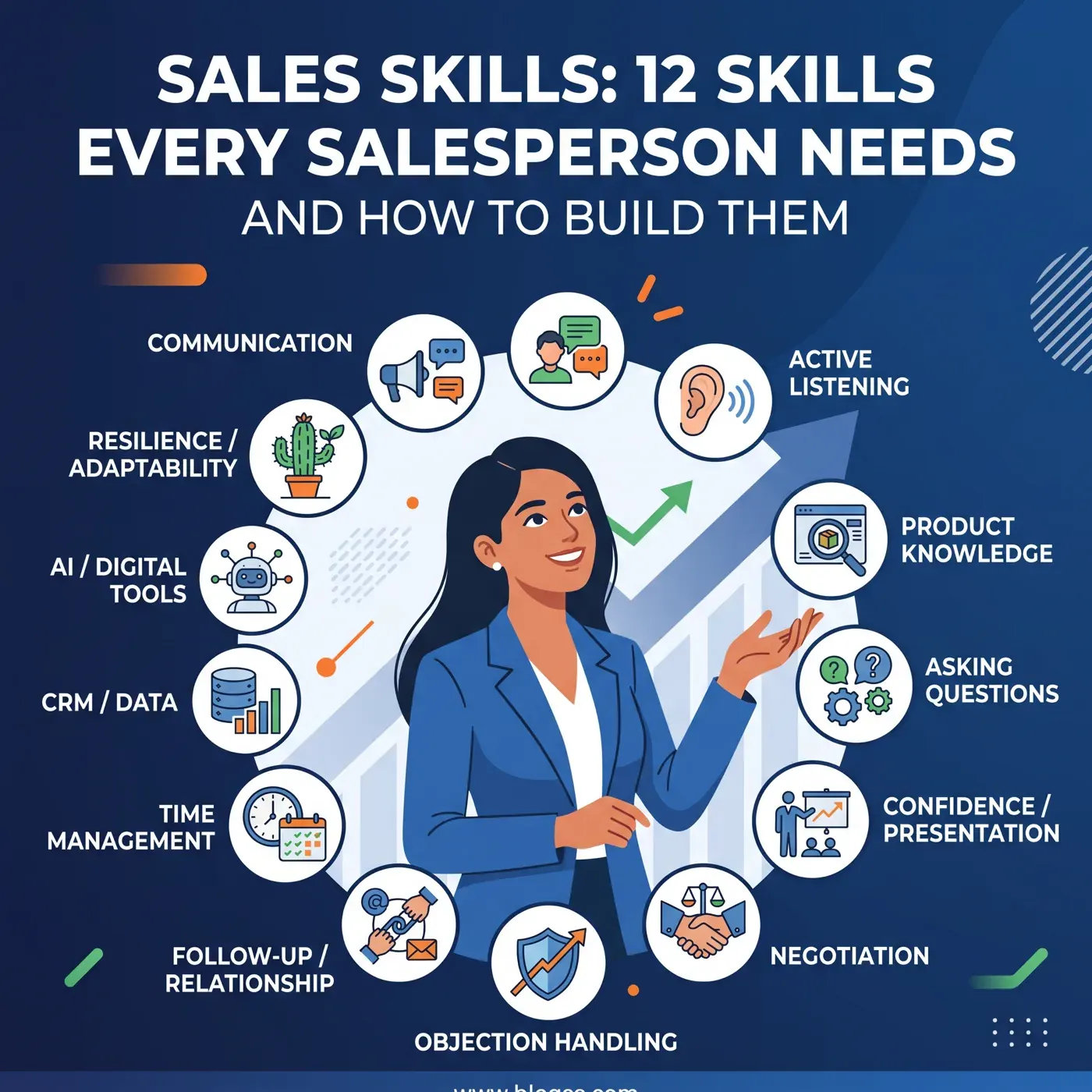
Sales skills are the abilities that help you understand customers, explain products, handle objections and close deals. For anyone starting a career in sales, the most important skills include communication, active listening, product knowledge, negotiation, follow-up, time management, and the ability to use CRM and AI tools.
You do not need to master all these skills before applying for a job. You can build them through regular practice, roleplays and real customer conversations.
Whether you want to become a Business Development Executive (BDE), Business Development Associate (BDA), sales executive or telecaller, these 12 skills will help you prepare for the job.
1. Communication Skills
Why it matters: Sales begins with a conversation. You need to explain what your company offers in simple language and help customers understand how it can solve their problems.
Good communication is not about using impressive words. It is about making your message clear. You should be able to speak confidently, write professional emails and explain a product without confusing the customer.
How to practise:
Choose a product you use every day, such as a mobile phone or a water purifier. Explain its three main benefits in 60 seconds. Record yourself and listen to the recording. Check whether your explanation is clear, relevant and easy to understand.
2. Active Listening
Why it matters: A salesperson should understand the customer's needs before suggesting a product. If you keep talking without listening, you may miss important details.
For example, a customer looking for a laptop may care more about battery life than processing speed. Recommending a high-performance laptop without understanding this requirement may not help.
Active listening means paying attention, asking relevant questions and confirming what you have understood.
How to practise:
Ask a friend to describe a problem they are facing. Listen without interrupting. Then explain the problem back to them in two or three sentences. Ask if you understood it correctly.
3. Product Knowledge
Why it matters: Customers expect salespeople to know what they are selling. You should understand the product's features, benefits, pricing, limitations and common uses.
You should also know how your product compares with alternatives. This helps you answer questions honestly instead of making promises you cannot keep.
How to practise:
Pick one product and prepare a simple product sheet with five points:
- What does it do?
- Who needs it?
- What problem does it solve?
- What are its main features?
- What are its limitations?
Try explaining the product to someone who has never used it.
4. Asking the Right Questions
Why it matters: A good salesperson does not assume what a customer wants. They ask questions to understand the customer's situation.
In a sales conversation, questions help identify the customer's budget, requirements, urgency and decision-making process.
For example, a BDE selling software to a small business could ask:
- How do you manage customer enquiries today?
- What problems do you face with your current process?
- How many enquiries do you receive in a month?
- When are you planning to make a change?
How to practise:
Choose a product and prepare five open-ended questions for a potential customer. Avoid questions that can be answered only with yes or no. Practise asking them naturally in a mock sales conversation.
5. Confidence and Presentation Skills
Why it matters: Customers are more likely to engage when a salesperson can explain an idea calmly and confidently. Confidence also helps during product demonstrations, client meetings and presentations.
However, confidence does not mean speaking loudly or dominating a conversation. It means knowing your subject, staying composed and communicating without unnecessary hesitation.
How to practise:
Prepare a two-minute presentation about a product. Deliver it in front of a friend or record a video. Focus on your posture, eye contact, pace and clarity. Repeat the presentation after reviewing your recording.
6. Negotiation Skills
Why it matters: Customers may ask for discounts, different payment terms or additional benefits. A salesperson must understand what can be offered and where the company must maintain its limits.
Good negotiation is not about agreeing to every demand. It is about finding a practical solution that works for both sides.
For example, if a customer finds a product expensive, you can explain its value, discuss a suitable package or clarify the available payment options. Never promise a discount or benefit without approval.
How to practise:
Ask a friend to act as a customer who wants a discount. Practise explaining the value of the product and offering an alternative without immediately reducing the price.
7. Handling Objections
Why it matters: Customers often have doubts before making a purchase. They may say the product is too expensive, they need more time or they are already using a competitor's service.
These objections do not always mean the customer is uninterested. Sometimes they simply need more information.
A good sales executive listens to the concern, understands its reason and responds with relevant information.
How to practise:
Write down five common objections for a product. Prepare a short, honest response to each one.
Customer objection and possible response
- "It is too expensive." I understand. May I explain what is included in the price?
- "I need more time." Certainly. Is there any specific information that would help you decide?
- "I already use another product." That's good to know. What do you like most about your current solution?
- "Please call later." Sure. What would be a convenient time for you?
- "I am not interested." Understood. May I ask if this is not a current requirement or if you have already found another solution?
The aim is to understand the objection, not pressure the customer.
8. Follow-up and Relationship Building
Why it matters: Not every customer makes a decision during the first conversation. Some need time to compare products, discuss the purchase with family or get approval from their manager.
Following up helps keep the conversation active. But repeated calls and messages without a clear reason can irritate customers.
A good follow-up should refer to the previous discussion and offer something useful.
How to practise:
Write a follow-up WhatsApp message for a customer who attended a product demo but has not responded.
For example:
"Hello Rahul, thank you for attending the demo yesterday. I wanted to check if you had a chance to review the details. Please let me know if you have any questions. I would be happy to help."
Practise writing messages that are short, polite and relevant.
9. Time Management and Lead Prioritisation
Why it matters: Sales teams often handle several leads at the same time. Some customers are ready to buy, while others are only exploring their options.
A salesperson must organise calls, meetings, demonstrations and follow-ups. Without a clear plan, important leads can get missed.
Prioritisation does not mean ignoring new or less urgent enquiries. It means deciding what needs attention first and ensuring every lead has a next step.
How to practise:
Create a simple lead tracker with these columns: Lead, Requirement, Priority and Next action.
Lead A
- Requirement: Wants a demo today
- Priority: High
- Next action: Schedule demo
Lead B
- Requirement: Comparing options
- Priority: Medium
- Next action: Share product details
Lead C
- Requirement: Requested a callback next week
- Priority: Follow-up
- Next action: Schedule callback
Update the tracker every day and review pending actions before starting new calls.
10. CRM and Data Management Skills
Why it matters: CRM stands for Customer Relationship Management. It is software that helps sales teams record customer details, track conversations and manage follow-ups.
Many sales roles involve working with CRM systems. A salesperson may need to update lead status, add call notes, schedule reminders and record the next action.
Accurate data helps the entire team understand what has happened with a customer.
How to practise:
Create a sample lead tracker in a spreadsheet or practise with a CRM training account. Record five sample leads and update their status after each mock conversation.
Learn these basic CRM activities:
- Adding a new lead
- Recording customer details
- Updating lead status
- Adding call notes
- Scheduling follow-ups
- Tracking the next action
11. AI and Digital Tool Skills
Why it matters: Sales teams are increasingly using digital tools to manage customer conversations, prepare messages, organise information and improve follow-ups.
A new salesperson does not need to know how to build AI systems. But understanding how to use them responsibly can make everyday work easier.
Here are some useful applications:
- Use AI writing tools to prepare a first draft of a sales email.
- Practise roleplay conversations with an AI tool.
- Use meeting transcription tools to organise discussion notes.
- Learn how AI calling and chat tools support initial customer engagement.
- Understand how information moves from an enquiry to a CRM record.
For example, a customer submits an enquiry on a website. An AI tool can help the business respond, collect basic details and support follow-up. The salesperson can then review the information and take the conversation forward.
You can read more about AI voice agents and their role in customer conversations.
How to practise:
Ask an AI tool to act as a customer who is interested in buying a product but has three objections. Conduct a mock conversation. Then review your responses and identify where you could have asked better questions or explained the product more clearly.
Remember: AI can assist with preparation and routine tasks, but you must check the information before sharing it with a customer.
12. Resilience and Adaptability
Why it matters: Sales involves rejection. A customer may not answer your call, may choose a competitor or may decide not to buy.
A salesperson needs to learn from these situations without losing focus. Resilience helps you stay consistent, while adaptability helps you change your approach when a conversation is not working.
For example, a customer may prefer WhatsApp over a phone call. Another may need a detailed product demonstration before making a decision.
How to practise:
After every mock sales call, write down:
- 1. What went well?
- 2. Where did the conversation become difficult?
- 3. What could you do differently next time?
Use the answers to improve your next attempt instead of repeating the same approach.
How to Improve Sales Skills: A Simple 30-Day Practice Plan
Reading about sales skills is useful, but practice helps you build them. You can follow this simple plan to start improving your sales executive skills.
Week 1
- What to practise: Communication, listening and product knowledge
- Expected outcome: Explain a product clearly and understand customer needs
Week 2
- What to practise: Asking questions, presentation and objection handling
- Expected outcome: Conduct a basic sales conversation
Week 3
- What to practise: Negotiation, follow-up and time management
- Expected outcome: Manage customer discussions and next steps
Week 4
- What to practise: CRM, AI tools and roleplay practice
- Expected outcome: Handle a structured mock sales process
At the end of 30 days, conduct a mock sales call from beginning to end. Start with an introduction, understand the customer's requirement, explain the product, handle objections and agree on a next step.
Record the conversation and review it. This will help you identify which skills need more practice.
Frequently Asked Questions About Sales Skills
1. What are the most important sales skills for a fresher?
The most important sales skills for a fresher include communication, active listening, product knowledge, asking questions, confidence, objection handling and follow-up. Basic CRM and digital tool knowledge can also help when applying for entry-level sales jobs.
2. How can I improve my sales skills without experience?
You can practise through mock sales calls, product presentations, roleplays and sample customer conversations. Record your practice sessions, review your responses and work on one skill at a time. You can also learn basic CRM and AI tools before applying for jobs.
3. What skills are required for a sales executive?
A sales executive needs communication, listening, negotiation, product knowledge, lead management, follow-up and relationship-building skills. Depending on the role, employers may also expect CRM knowledge, basic spreadsheet skills and familiarity with AI-assisted sales tools.
4. Are AI and CRM skills important for sales jobs?
Yes. Many sales teams use CRM systems to track leads and customer interactions. AI tools can also support tasks such as drafting messages, preparing call summaries and practising sales conversations. Learning the basics can help freshers prepare for technology-supported sales roles.
Build Your Sales Skills with Practical Training
Sales is a skill-based career. You do not need years of experience to get started, but you do need to practise how to speak with customers, understand their needs and handle real sales situations.
If you are a student, fresher or early-career professional preparing for a sales role, practical training can help you become more confident before entering the workplace.
Explore the Skalix Academy to learn more about sales training and practical learning opportunities.
Start practising today. Your next sales conversation is an opportunity to improve.