
Every sales conversation contains valuable information.
A customer mentions a budget concern. Another asks for a competitor comparison. Someone else says they're interested but wants to revisit the discussion next month. Individually, these moments may seem ordinary. Collectively, they reveal patterns that can reshape an entire sales strategy.
The challenge is that no manager has the time to listen to every call. Even if they did, memory is imperfect, notes are inconsistent, and important signals often go unnoticed. This is where call analysis AI is changing the game. Instead of sampling a handful of conversations each week, businesses can now analyze every interaction automatically and uncover insights that would otherwise remain hidden.
Quick Answer: How Does AI Analyze Sales Calls?
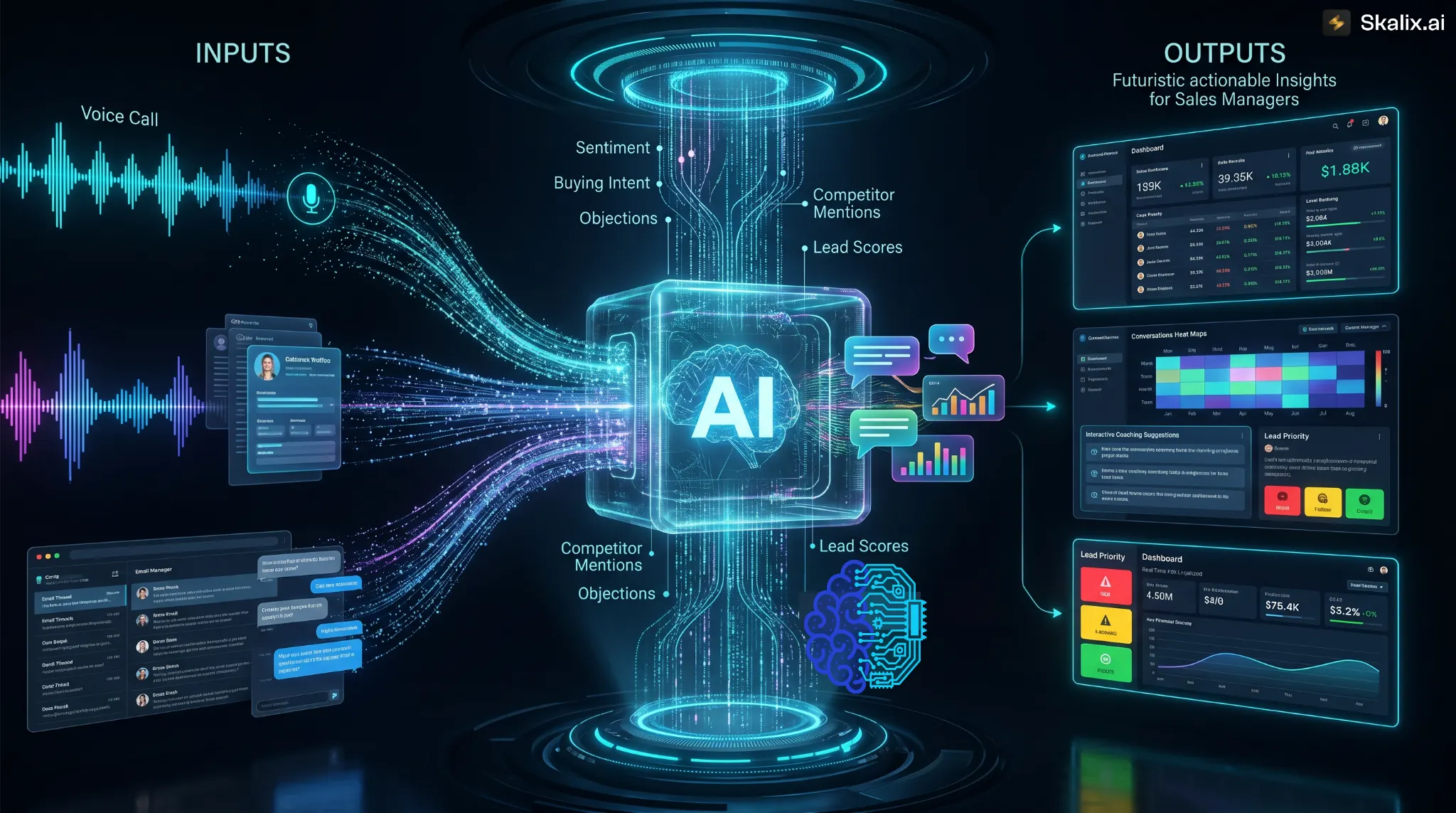
AI analyzes sales calls through a continuous 4-stage pipeline that captures spoken, shared, and shown interactions:
- 1. Multi-modal Capture (Spoken, Shared, and Shown): The platform ingests dual-channel call audio alongside video streams (screen shares, demo slides, and shared documents) and live meeting chat messages.
- 2. Speech-to-Text & Acoustic Intelligence: High-accuracy models transcribe conversation streams while tracking speech acoustics—including pitch, speaking velocity, silence pauses, and talk-to-listen ratios.
- 3. Contextual NLP & Intent Classification: Natural language processing parses dialogue to detect buying signals, discount requests, timeline commitments, and competitor mentions in context.
- 4. Automated CRM Sync & Competitive Intelligence: Key insights, call summaries, and next steps are automatically written into CRM deal records, giving sales leaders aggregate competitive analytics across every call.
Call Analysis AI Makes Every Sales Conversation Actionable
Traditional call reviews rely heavily on random sampling. Managers may listen to a few calls for coaching, but thousands of conversations remain untouched. That means recurring objections, buying signals, and coaching opportunities often slip through the cracks.
Call analysis AI changes that completely.
By analyzing 100% of customer conversations, AI identifies patterns across every call- not just the ones someone had time to review. It can detect recurring objections, identify successful talk tracks, measure customer sentiment, track competitor mentions, and highlight conversations that require immediate attention.
Instead of guessing what works, sales leaders gain evidence backed by data.
Related Reading: Learn how SmartGreet AI helps businesses engage customers through intelligent voice conversations
Modern Sales Conversation Intelligence Goes Beyond Transcription
Modern sales conversation intelligence goes far beyond transcription. It understands context.
Imagine two prospects asking the same question about pricing. One is simply gathering information, while the other is comparing vendors before making a purchase decision. Although the words may sound similar, the intent is very different.
AI can recognize these differences by evaluating tone, conversation flow, response patterns, and customer engagement. As a result, sales teams receive richer insights than a simple call recording could ever provide.
This allows managers to coach based on real customer behavior rather than assumptions.
When Conversation Intelligence Connects With CRM
The impact becomes even more significant when conversation intelligence is connected with CRM systems.
Every interaction automatically enriches the customer profile. Instead of manually entering notes after every call, AI captures discussion summaries, buying intent, objections, preferred language, follow-up commitments, and next steps.
When the sales representative reconnects with the customer, they continue the conversation instead of restarting it.
This creates a smoother customer experience while saving valuable time for the sales team.
Related Reading: Explore how AI-powered customer engagement improves lead qualification
How Conversation Intelligence Improves Lead Qualification
Conversation intelligence also plays an important role in lead qualification.
Modern AI voice agents for lead qualification can handle first-touch conversations, identify buying intent, qualify prospects, and transfer structured insights directly to sales representatives. Rather than asking customers the same qualifying questions repeatedly, sales teams begin every conversation with meaningful context.
Similarly, an autonomous sales agent for B2B continuously captures valuable customer signals throughout the buying journey. It ensures that high-intent prospects are surfaced quickly while lower-priority leads continue to receive automated engagement until they are ready to speak with a human representative.
How Call Analysis AI Improves Sales Coaching
Another advantage of call analysis AI is coaching.
Traditionally, coaching depended on a manager's availability and memory. Today, AI highlights exactly where conversations succeeded or struggled. Managers can review moments where customers expressed hesitation, interrupted the sales pitch, asked about competitors, or showed strong buying intent.
Instead of generic feedback like "Build better rapport," coaching becomes highly specific.
Sales representatives improve faster because they learn from real conversations- not theoretical examples.
Connecting Conversation Intelligence to Revenue Operations
Many organizations are also integrating conversation intelligence into broader revenue operations.
A modern GTM AI agent doesn't simply analyze calls. It combines conversation insights with CRM activity, pipeline movement, customer engagement, and historical performance to recommend the next best action.
This enables sales managers to prioritize coaching, RevOps teams to identify pipeline risks, and leadership to forecast revenue with greater confidence.
The result is a more connected sales organization where decisions are driven by evidence rather than intuition.
Related Reading: Discover how Skalix AI helps businesses automate customer conversations and revenue workflows
Conclusion
The real value of AI isn't that it listens to more conversations than humans ever could.
It's that it transforms thousands of disconnected conversations into clear, actionable intelligence.
When every interaction contributes to a better understanding of customers, sales teams stop relying on guesswork. They coach more effectively, prioritize smarter, respond faster, and ultimately close more business.
As AI continues to become part of everyday sales workflows, organizations that embrace call analysis AI and sales conversation intelligence won't just hear more customer conversations.
They'll understand them better.
FAQs
1. What is call analysis AI?
Call analysis AI uses artificial intelligence to analyze sales conversations, identify customer intent, detect objections, measure sentiment, and provide actionable insights for sales teams.
2. How does sales conversation intelligence improve sales performance?
Sales conversation intelligence helps businesses analyze every customer interaction, improve coaching, identify successful sales patterns, prioritize opportunities, and increase conversion rates.
3. Why is call analysis AI important for modern sales teams?
Call analysis AI eliminates manual call reviews, captures valuable customer insights at scale, improves forecasting, supports sales coaching, and enables faster, more informed decision-making.
4. How can using AI in sales capture and analyze spoken, shared, and shown interactions from recent calls with prospects?
Modern AI sales tools integrate natively with conferencing and VoIP platforms. They capture spoken audio via dual-stream recording, extract shown interaction data from screen-shares and slides via computer vision / OCR, and log chat messages—indexing all three streams into a searchable, time-stamped call intelligence record.
5. How is AI competitive analysis performed from sales conversations?
Call analysis AI tracks all competitor brand and product mentions across calls. It tags whether each mention was raised by the rep or prospect, classifies the associated sentiment (positive, negative, or neutral), and surfaces win/loss themes so product marketing and sales teams can refine their battlecards.
6. What are the risks of using AI chatbots to analyze competitor mentions in sales calls?
The main risks are context misinterpretation (classifying a casual mention as a serious lost deal), privacy and security leaks if call transcripts are passed into unvetted public LLMs, and lack of domain nuance without proper prompt calibration and CRM grounding.
Explore AI call analytics software for reporting on calling outcomes and sales conversations.