
Most founders know the feeling.
The dashboard looks healthy. Lead volumes are growing. Marketing campaigns are generating interest. On paper, the funnel appears to be working exactly as planned.
Yet revenue tells a different story.
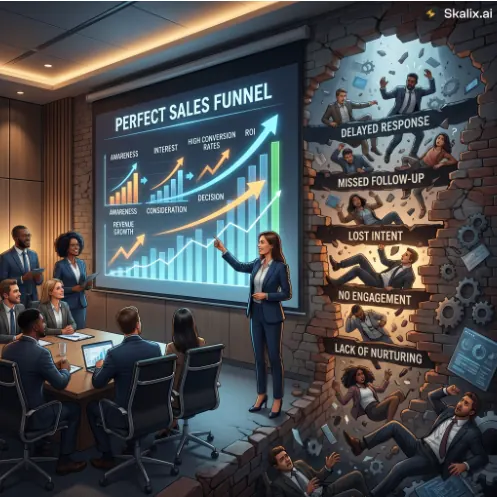
This disconnect sits at the heart of many modern B2C sales challenges. Companies invest heavily in funnel optimization, build sophisticated customer journeys, and track dozens of conversion metrics. Still, prospects disappear before becoming customers.
The problem is rarely the funnel design itself.
It's what happens between the stages.
Understanding B2C Sales Challenges Beyond Funnel Optimization
When teams discuss funnel optimization, they often focus on improving landing pages, ad creatives, conversion forms, and campaign targeting.
Those elements matter.
But customers don't experience a funnel as a diagram. They experience it as a series of interactions.
A prospect who fills out a form expects a response. Someone who requests information expects guidance. A customer who shows intent expects momentum.
When those expectations are not met, drop-offs begin.
Not because demand disappeared.
Because engagement did.
Related reading:
The first response time problem that's costing you customers
Many businesses assume they have a lead-generation problem when they actually have a response-time problem.
The difference is significant.
Generating another thousand leads will not solve a system that struggles to engage the leads it already has.
This is where many funnels silently break.
A delayed response by a few hours. An incomplete follow-up sequence. A prospect who has a question but receives no immediate answer.
Individually, these moments seem small.
Collectively, they determine whether revenue grows.
Why Beautiful Funnels Break in Real Life
Slide decks are linear.
Customers are not.
A prospect may discover your brand on Instagram, visit your website later, submit an inquiry from a laptop, and respond through WhatsApp two days afterward.
Traditional funnels rarely account for this behavior.
Real-world customer journeys are fragmented, dynamic, and unpredictable.
The companies that consistently outperform competitors understand this reality. Rather than forcing customers into predefined paths, they create systems that respond intelligently regardless of where engagement begins.
This is why AI voice agents for lead qualification are becoming increasingly important.
Instead of waiting for sales representatives to manually review every inquiry, AI can engage prospects instantly, qualify intent, answer common questions, and route conversations appropriately.
The result is not simply automation.
It is continuity.
👉 Explore more on the Skalix website
The Missing Layer Between Interest and Conversion
Many organizations invest heavily at the top of the funnel.
They spend less attention on what happens afterward.
This creates a dangerous gap between customer intent and customer action.
A prospect who is ready to buy today may not be ready tomorrow.
That is why timing often matters more than volume.
Modern AI systems are helping bridge this gap through intelligent engagement. A GTM AI agent can identify high-intent prospects, trigger personalized outreach, and ensure conversations continue without unnecessary delays.
Similarly, an autonomous sales agent for B2B can handle repetitive qualification and follow-up tasks, allowing sales teams to focus on strategic conversations.
While these technologies are often associated with B2B environments, the underlying principle applies equally to B2C funnels.
The faster and more consistently you engage customers, the less opportunity there is for intent to fade.
Funnel Optimization Is Really About Momentum
The highest-performing funnels are not necessarily the most complex.
They are the most responsive.
Customers rarely abandon a funnel because they dislike the design.
More often, they leave because momentum was lost.
The brands that win are the ones that maintain engagement throughout the journey. They remove friction, answer questions quickly, and create a seamless experience across channels.
That's where AI-driven engagement becomes a competitive advantage.
Not because it replaces people.
Because it ensures that no interested customer feels ignored.
Conclusion
Most B2C sales challenges are not caused by poor marketing or weak demand.
They stem from gaps in engagement that slowly erode customer intent.
Effective funnel optimization is about more than conversion rates and dashboards. It is about ensuring every prospect receives timely, relevant, and continuous engagement.
At Skalix AI, we help businesses close these gaps with intelligent engagement systems that qualify leads, automate follow-ups, and create seamless customer experiences across channels.
Because the strongest funnels are not the ones that look good on slides.
They're the ones that deliver results in reality.
FAQs
1. What are the biggest B2C sales challenges today?
The biggest B2C sales challenges include delayed responses, inconsistent follow-ups, fragmented customer journeys, and loss of customer intent between funnel stages.
2. How does funnel optimization improve B2C conversions?
Funnel optimization improves conversions by reducing friction, improving customer engagement, accelerating response times, and ensuring prospects receive timely support throughout the buying journey.
3. Can AI help solve B2C sales challenges?
Yes. AI solutions such as AI voice agents for lead qualification, GTM AI agents, and automated engagement systems can improve response speed, reduce drop-offs, and increase overall conversion rates.