
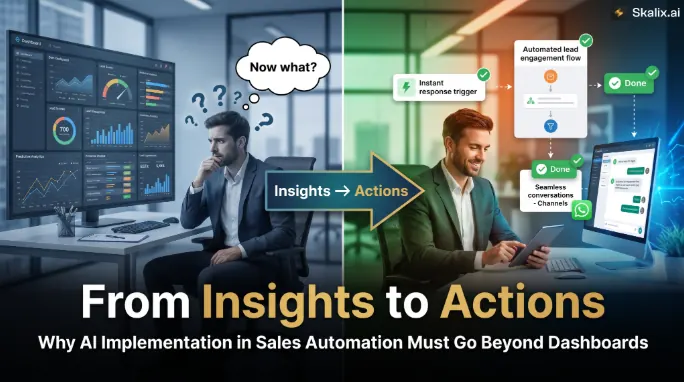
Most AI implementation conversations in sales automation start with dashboards.
Better insights. Cleaner reports. Smarter analytics.
And yet, despite all this intelligence, sales outcomes often remain unchanged.
Pipelines still leak. Follow-ups are still inconsistent. High-intent leads still go cold.
The problem isn't that AI isn't working.
It's that most AI workflows stop at insights- and never translate into action. Many businesses are now experimenting with systems like GTM AI agents and intelligent automation tools, but the challenge remains the same: intelligence without execution creates very little business impact.
AI Implementation That Stops at Insights
A typical AI implementation in sales automation looks something like this:
- Lead scoring dashboards
- Predictive analytics
- Conversion probability indicators
- Customer behavior reports
All useful. All informative.
But here's the uncomfortable truth:
Insights don't close deals. Actions do.
Sales teams don't lose opportunities because they lack data.
They lose them because the right action didn't happen at the right time.
A lead wasn't followed up.
A response was delayed.
A conversation lost momentum.
And no dashboard fixes that.
👉 Explore how intelligent engagement bridges this gap
From AI Insights to AI Workflows
The shift that most businesses miss is simple- but fundamental:
Moving from knowing what to do to ensuring it gets done.
This is where AI workflows come in.
Instead of just surfacing insights, action-driven AI:
- Triggers instant responses to inbound leads
- Automates follow-ups based on intent signals
- Routes conversations intelligently
- Maintains continuity across channels
- Uses AI voice agents for lead qualification to engage prospects the moment they enter the funnel
In other words, it operationalizes intelligence.
The system doesn't just tell you a lead is hot.
It engages that lead immediately.
Modern GTM AI agents are increasingly being designed around this principle- reducing the time between signal and action.
👉 See how omnichannel workflows operate
Why Most Sales Automation Fails
Despite heavy investment in sales automation, failure rates remain high.
Not because the tools are ineffective- but because they are incomplete.
Most systems:
- Depend on human execution after insight
- Introduce delays between signal and action
- Fragment conversations across channels
- Require constant manual intervention
The result?
A gap between intelligence and execution.
And that gap is where revenue disappears.
The longer the delay between insight and action, the lower the probability of conversion.
Organizations often assume technology alone creates efficiency. But unless systems move from recommendations into real-world execution, automation remains partial.
The Skalix Philosophy: Action-First AI
At Skalix, AI isn't designed to inform your sales team.
It's designed to act with them.
This means:
- Every inbound lead is engaged instantly
- Qualification happens within the conversation
- Context is preserved across touchpoints
- Follow-ups are automated, not remembered
- AI voice agents for lead qualification ensure high-intent conversations begin immediately, even beyond business hours
Rather than functioning like passive assistants, systems today increasingly resemble an autonomous sales agent for B2B teams- engaging leads, qualifying conversations, and progressing opportunities continuously.
The focus shifts from dashboards to outcomes.
From analysis to execution.
From "what should we do next?"
to
"It's already happening."
👉 Learn how SmartGreet powers action-driven engagement
The Real ROI of AI Workflows
When AI implementation moves from insights to actions, the impact becomes measurable:
- Faster response times (seconds, not hours)
- Higher lead coverage (no missed opportunities)
- Increased conversion rates
- Reduced manual workload for sales teams
But the biggest shift is subtle.
Sales stops depending on individual consistency.
And starts running on system-driven execution.
The difference isn't simply better reporting.
It's creating workflows that behave like active participants inside the sales process rather than observers.
Conclusion
Most AI in sales doesn't fail because it lacks intelligence.
It fails because it stops short of execution.
Insights tell you what matters.
Actions make it matter.
The future of AI implementation in sales automation isn't about better dashboards.
It's about building AI workflows that ensure every opportunity is acted upon- instantly, consistently, and intelligently.
Whether that takes the form of GTM AI agents, AI voice agents for lead qualification, or an autonomous sales agent for B2B, the direction is becoming increasingly clear:
AI must move beyond informing teams.
It must help execute alongside them.
👉 Explore how Skalix enables action-driven AI
FAQs
1. Why does AI implementation fail in sales automation?
Most AI implementation efforts fail because they focus only on insights like dashboards and analytics, without enabling real-time actions such as automated responses and follow-ups.
2. What is the difference between AI insights and AI workflows?
AI insights provide information and recommendations, while AI workflows take action automatically- engaging leads, triggering responses, and driving outcomes without manual intervention.
3. How can AI workflows improve sales automation results?
AI workflows improve sales automation by ensuring timely engagement, consistent follow-ups, and seamless execution. Technologies like AI voice agents for lead qualification, GTM AI agents, and even an autonomous sales agent for B2B environments help reduce manual effort while improving conversions and response speed.