
Revenue intelligence has quickly become one of the most discussed concepts in modern B2B growth. Yet despite the buzz, many leaders still struggle to answer a simple question: What exactly is revenue intelligence, and how is it different from traditional sales reporting?
The confusion is understandable. Most organizations already have dashboards, CRM systems, and sales reports. They have access to data. What they often lack is context.
And that distinction matters.
Data tells you what happened. Revenue intelligence helps explain why it happened and what should happen next.
Revenue Intelligence Is More Than Another Dashboard
For years, sales teams have relied on historical reports to evaluate performance. A manager could see how many calls were made, how many opportunities were created, and how many deals were won.
The problem is that these metrics are backward-looking.
By the time leaders identify a problem, revenue may have already been impacted.
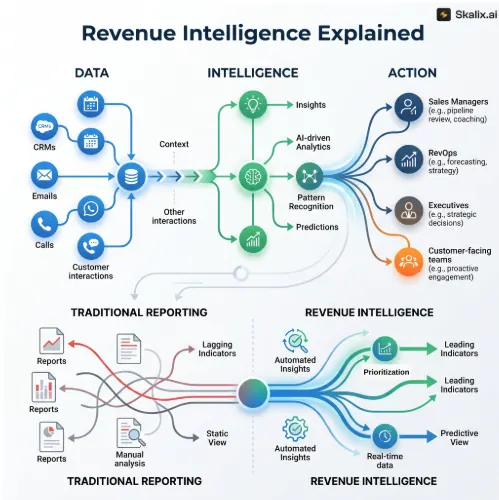
Revenue intelligence changes this approach. Instead of simply tracking activities, it connects data from conversations, customer interactions, pipelines, and engagement signals to create a clearer picture of revenue health.
A sales leader no longer has to wonder why conversion rates are declining. A RevOps team no longer has to spend days piecing together reports from multiple systems. Revenue intelligence surfaces patterns and signals that would otherwise remain hidden.
Related Reading: SmartGreet AI
Why RevOps Teams Are Investing in Revenue Intelligence
RevOps exists to align sales, marketing, and customer success around a common objective: predictable growth.
In theory, that sounds straightforward.
In reality, every department works with different tools, different metrics, and different definitions of success. Marketing celebrates lead generation. Sales focuses on pipeline creation. Customer success prioritizes retention.
Revenue intelligence acts as a shared source of truth.
It allows RevOps leaders to understand how prospects move through the funnel, where opportunities stall, and which activities actually influence revenue outcomes. Instead of operating on assumptions, teams can make decisions based on evidence.
This becomes especially important as organizations scale. The larger the pipeline becomes, the harder it is to identify risks early without intelligent visibility.
Related Reading: Omnichannel Customer Engagement
From Sales Intelligence to Revenue Intelligence
Traditional sales intelligence focuses on prospects and accounts. It helps teams identify potential buyers, gather contact information, and prioritize outreach.
Revenue intelligence goes a step further.
It examines what happens throughout the customer journey.
Which conversations lead to meetings?
Which objections appear most frequently?
What behaviors signal purchase intent?
Why do some opportunities move faster than others?
These insights allow organizations to improve not only prospecting but also forecasting, coaching, pipeline management, and customer engagement.
This is where technologies such as AI voice agents for lead qualification play an increasingly important role. Every customer interaction generates valuable information. When those conversations are analyzed and connected to business outcomes, leaders gain a much deeper understanding of what drives revenue.
Similarly, a GTM AI agent can identify patterns across thousands of customer interactions and highlight opportunities that may otherwise go unnoticed. An autonomous sales agent for B2B can automate repetitive engagement tasks while simultaneously generating intelligence that helps sales teams focus on the right prospects.
How Leaders Actually Use Revenue Intelligence
The most successful organizations are not using revenue intelligence simply to build prettier reports.
They use it to make better decisions.
Sales managers use it to coach teams more effectively.
RevOps leaders use it to identify bottlenecks before they impact performance.
Executives use it to improve forecasting accuracy and understand future revenue risk.
Customer-facing teams use it to engage prospects with better timing and greater relevance.
In every case, the goal is the same: reduce uncertainty and improve decision-making.
Because revenue growth rarely comes from having more data.
It comes from understanding which data matters.
Conclusion
Revenue intelligence is rapidly becoming a critical capability for modern growth organizations. As pipelines become more complex and customer journeys become less predictable, leaders need more than reports. They need insight.
By combining sales intelligence, conversation intelligence, AI-powered engagement, and RevOps visibility, businesses can move from reactive decision-making to proactive revenue management.
At Skalix AI, we help organizations capture valuable customer signals through AI-powered conversations, intelligent lead qualification, and automated engagement workflows that transform interactions into actionable revenue intelligence.
Explore SmartGreet AI, AI Voice Agents, and Sales Automation Solutions to learn how your team can turn customer conversations into growth opportunities.
FAQs
1. What is revenue intelligence?
Revenue intelligence is the process of collecting and analyzing sales, customer, and engagement data to help organizations understand revenue performance, identify opportunities, and make better business decisions.
2. How does revenue intelligence help RevOps teams?
Revenue intelligence helps RevOps teams align sales, marketing, and customer success by providing a unified view of pipeline performance, customer engagement, forecasting, and revenue drivers.
3. What is the difference between revenue intelligence and sales intelligence?
Sales intelligence focuses primarily on identifying and researching prospects. Revenue intelligence expands beyond prospecting to analyze conversations, pipeline activity, customer interactions, and revenue outcomes across the entire customer journey.