
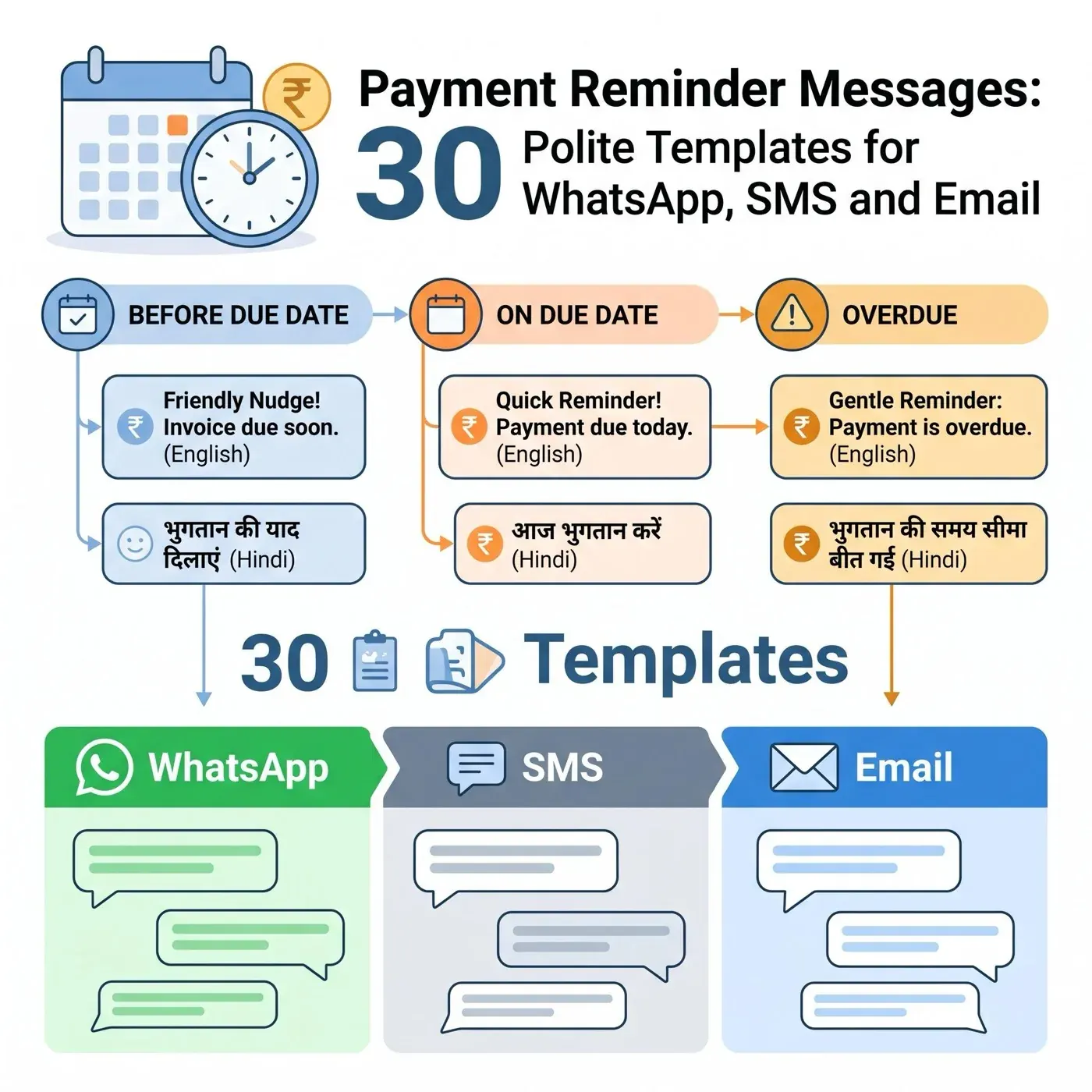
Introduction
A good payment reminder message is polite, clear and easy to act on. Whether you are reminding a customer about an upcoming invoice, a pending EMI or an overdue payment, the message should mention the amount, due date and payment method wherever possible.
Businesses in India can use WhatsApp, SMS and email to send payment reminders at different stages. The key is to send the right message at the right time without sounding rude or putting unnecessary pressure on the customer.
In this blog, you'll find 30 ready-to-use payment reminder messages in English and Hindi, covering upcoming payments, due dates and overdue invoices.
Quick Copy-Paste: Short Payment Reminders (With "Please Ignore If Already Paid")
Need a polite, effective reminder message right now? Copy and paste these templates:
Payment Reminder Messages Before the Due Date
Send these reminders a few days before payment is due. The aim is to help customers plan their payment and avoid missing the deadline.
English Templates
Hindi Templates
Payment Reminder Messages on the Due Date
On the due date, keep the message direct and courteous. Make it easy for the customer to complete the transaction.
English Templates
Hindi Templates
Overdue Payment Reminder Messages: 7 Days Late
If payment is still pending seven days after the due date, send a follow-up. Avoid accusatory language. Give the customer an opportunity to explain if there is a delay or payment issue.
English Templates
Hindi Templates
Overdue Payment Reminder Messages: 30 Days Late
A payment that remains pending for 30 days may need a more direct follow-up. Clearly state the outstanding amount and ask the customer to contact your team if there is a dispute or difficulty.
English Templates
Hindi Templates
EMI Reminder Messages
EMI reminders are useful for banks, NBFCs, lending businesses and other organisations that collect recurring instalments. Always verify the due date and amount before sending.
English Templates
Hindi Templates
For more specialised examples, see 25 EMI and loan reminder messages and 20 payment reminder messages in Hindi.
When Does a Payment Reminder Call Work Better Than a Message?
Messages work well for simple reminders. However, a call may be more useful when:
- A customer has ignored multiple reminders.
- The payment amount is significant.
- The customer needs help understanding the outstanding amount.
- There is a payment dispute or technical issue.
- A business needs to confirm a payment commitment.
- The customer prefers speaking to someone.
A message can tell a customer that a payment is due. A conversation can help identify why it has not been paid.
How AI Reminder Calls Help Businesses Manage Payments at Scale
For businesses managing hundreds or thousands of pending payments, manual follow-ups can take considerable time.
AI voice agents can automate parts of this process through a structured workflow:
- 1. Payment data received: The system identifies customers with upcoming or overdue payments.
- 2. Reminder call placed: An AI voice agent contacts the customer using an approved workflow.
- 3. Customer response understood: The agent can identify whether the customer intends to pay, needs assistance or disputes the amount.
- 4. Next step recorded: The system can capture a payment commitment, schedule a follow-up or route the case to a human team.
- 5. Records updated: Call outcomes and summaries can be shared with the CRM or relevant system.
For example, a lending company can use AI reminder calls to contact customers about upcoming EMIs, record their responses and identify accounts that need human attention.
SmartGreet AI can help businesses manage voice-based customer conversations and follow-ups at scale. Instead of asking collection teams to make every routine reminder call manually, businesses can automate suitable conversations while keeping human teams available for complex cases.
For a practical implementation guide, read how to automate payment reminders for Indian businesses.
Automation should always operate within the organisation's approved customer-contact, privacy and recovery policies.
Best Practices for Sending Payment Reminders in India
A payment reminder should make it easier for customers to pay, not make them uncomfortable.
Keep these points in mind:
- Mention the correct amount, due date and invoice or account reference.
- Use a verified payment link or the customer's usual payment channel, such as UPI.
- Keep WhatsApp messages short and emails clear.
- Use the customer's preferred language where possible.
- Avoid sharing sensitive payment or loan information in public or group messages.
- Stop unnecessary follow-ups once payment is confirmed.
- Provide a contact option for disputes or payment-related questions.
- Follow applicable consent, telecom and lender-specific communication requirements.
For regulated lenders, RBI guidance prohibits intimidation and harassment during recovery, including persistent calls, inappropriate messages and calls at prohibited hours. TRAI also regulates commercial communications and customer preferences. Businesses should review the rules that apply to their specific communication type.
Useful references:
- RBI – Responsibilities of Regulated Entities Employing Recovery Agents
- TRAI – Customer Preference Registration
- TRAI – Unsolicited Commercial Communication
Frequently Asked Questions
1. How do I write a polite payment reminder message?
Mention the customer's name, outstanding amount and due date. Keep the tone respectful and include a verified payment link or contact number. Avoid threatening or accusatory language.
2. How do I send a payment reminder message on WhatsApp?
Use a short, personalised message with the amount, due date and payment link. Send it through an appropriate business communication channel and follow applicable consent and messaging requirements.
3. How do I write a gentle reminder for payment after the due date?
You can write: "Hello [Name], our records show that Rs [Amount] due on [Date] is still pending. Could you please share an update? If you have already paid, kindly share the transaction reference. Thank you."
4. How many payment reminders should a business send?
There is no single number suitable for every business. Create a reasonable schedule based on the payment type, customer agreement and applicable rules. Avoid excessive or repeated contact.
5. Can AI make EMI reminder calls?
AI voice agents can handle suitable automated reminder conversations, capture customer responses and route complex cases to human teams. The business must ensure that its calling process follows applicable telecom, privacy and lender-specific requirements.
6. How do you politely say 'please ignore this message if you have already paid'?
Place the disclaimer at the very end of your SMS or WhatsApp reminder: "Please ignore this message if you have already paid." or "If already paid, kindly ignore this reminder with our thanks." This protects customer relationships and prevents confusion when payments are processing in the background.
7. What should be included in a short payment reminder text message?
A high-converting short payment reminder needs four elements: the customer's name, the exact amount due, the due date (or invoice number), and a direct payment link, followed by a polite ignore-if-paid note.