
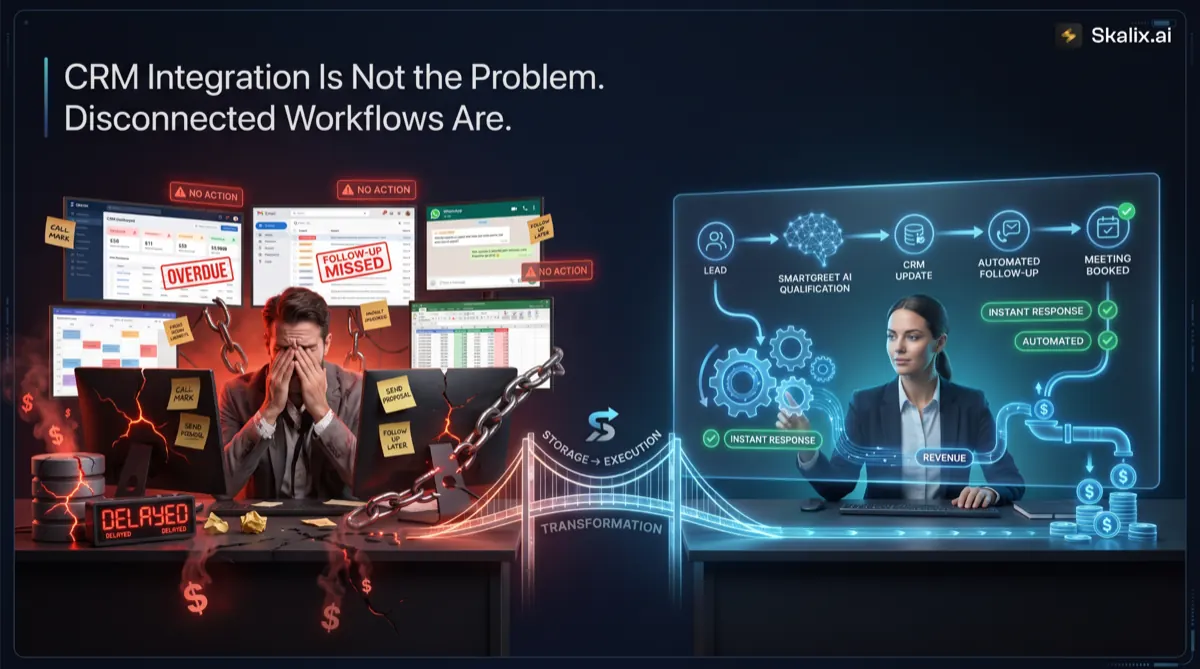
Your CRM is probably not the reason leads are slipping through the cracks. The bigger problem is what happens around it. A lead fills out a form, calls the business, sends a WhatsApp message or responds to an ad. The information enters one system, but the next action may still depend on a salesperson noticing it, updating the CRM and remembering to follow up.
That is where revenue starts leaking.
A CRM can store customer information beautifully. But storage is not execution. When teams rely on manual handoffs between marketing, sales, CRM and customer communication tools, even a well-maintained system can become another place where information waits.
Explore how Skalix approaches connected revenue workflows
CRM Integration Only Works When Workflows Connect
Most businesses already have several tools doing different jobs. Marketing captures leads. The CRM stores them. Sales representatives make calls. WhatsApp handles conversations. Calendars manage meetings. Managers track performance.
The problem is rarely the number of tools. It is the space between them.
A prospect may show strong buying intent during a call, but that information might remain buried in a recording. Another prospect may reply on WhatsApp but receive a follow-up hours later. Someone else may ask for a callback and never get one.
Good CRM integration should do more than move data from one system to another. It should help trigger the right action at the right time.
See how SmartGreet AI supports intelligent first response and engagement
The Missing Layer Is Sales Workflow Automation
This is where sales workflow automation becomes important.
Imagine a new enquiry arriving at 10:02 AM. An AI agent responds immediately. It asks the relevant qualification questions, understands the prospect's intent and captures the conversation. The CRM is updated automatically. If the lead is sales-ready, the right salesperson receives the context. If the prospect needs more time, a follow-up is triggered.
No spreadsheet. No sticky note. No "I'll get back to them later."
This is also where AI voice agents for lead qualification can make a practical difference. Instead of using AI only for answering questions, businesses can use it to perform the repetitive first layer of sales conversations while human teams focus on opportunities that need judgment and persuasion.
What SmartGreet AI Changes
SmartGreet AI is designed around this gap between customer interest and sales action.
A lead does not become valuable simply because it exists in the CRM. Someone has to respond, qualify it, understand the context and decide what happens next.
SmartGreet can engage leads across channels, qualify conversations and pass structured information into the sales process. This means the CRM becomes part of an active workflow rather than a database that salespeople have to keep updating manually.
For larger B2B sales teams, the same thinking can extend toward an autonomous sales agent for B2B. The goal is not to remove the salesperson. It is to remove the repetitive work that prevents salespeople from spending enough time with serious buyers.
Explore Skalix AI's latest sales automation insights
From CRM Data to Actual Revenue
The next step is connecting the signals.
A customer calls. The conversation generates intent data. The CRM receives the information. A follow-up is scheduled. The salesperson gets context. Management can see what happened.
That is much more useful than simply knowing that a lead was created.
A GTM AI agent can take this further by connecting customer signals across the revenue journey and helping teams decide what should happen next. The real value of AI is not another dashboard. It is reducing the distance between an event and the action that follows it.
Conclusion
Your CRM may not need replacing.
Your workflow may need redesigning.
When customer conversations, CRM data, lead qualification and follow-ups operate as disconnected activities, sales teams spend too much time chasing information and too little time acting on it.
The better approach is to connect the workflow around the CRM. With SmartGreet AI, businesses can move toward faster engagement, automated qualification and more consistent follow-through.
Because the goal isn't to build a better database.
It is to build a revenue process that actually moves.
See Skalix AI's revenue automation platform
FAQs
1. Why is CRM integration important for sales teams?
CRM integration connects customer data with the tools and workflows used by sales teams. Effective CRM integration helps reduce manual updates, improve visibility and ensure important customer signals lead to timely action.
2. How does sales workflow automation improve CRM integration?
Sales workflow automation connects events such as new enquiries, conversations, qualification and follow-ups. Instead of simply storing information in the CRM, automation helps turn that information into the next action.
3. Can AI voice agents for lead qualification work with a CRM?
Yes. AI voice agents for lead qualification can capture customer responses, identify intent and pass structured information into connected sales workflows. This gives sales teams useful context before they engage with a prospect.