
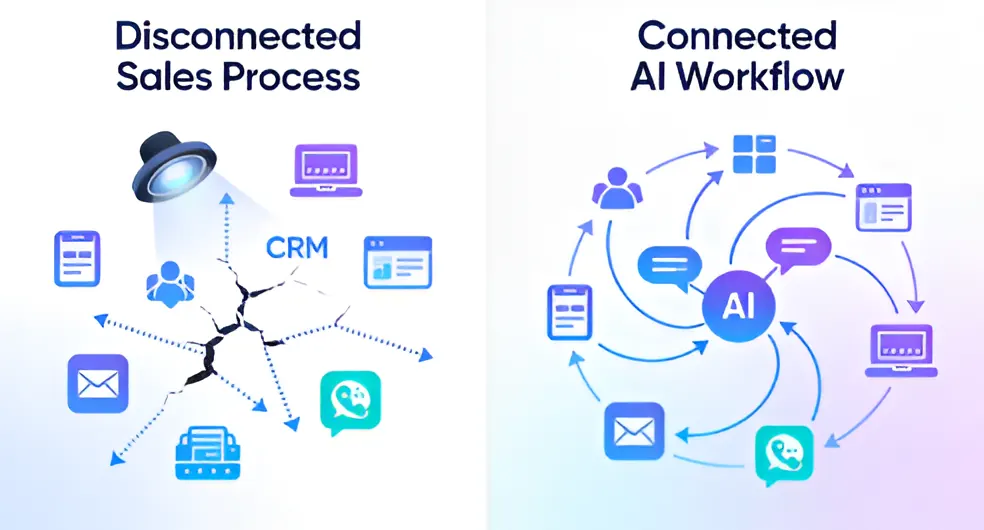
AI was intended to address long standing sales problems. Quicker insights, improved forecasts, and more intelligent interaction with prospects were expected to change the way sales teams operate. However, even after implementing AI, many teams continue to experience stalled deals, irregular follow-ups, and uncertain results.
AI in sales doesn't covertly fix flawed procedures in the background. Rather, it exposes hidden inefficiencies. Even though that visibility can initially be unsettling, significant progress frequently starts there.
AI in Sales Clarifies Chaos, Not Improves It
AI in sales typically acts more as an observer than an active participant when it operates outside of a company's actual workflows. Although it can analyze data, find patterns, reveal helpful signals, and even produce recommendations, the day-to-day execution of sales activities frequently stays the same.
Handoffs between teams still disrupt the momentum of a deal, and conversations still lack the context necessary to proceed smoothly. The opportunity might have passed by the time new information emerges. In these situations, the issue is rarely the capability of sales AI itself. The real challenge lies in the surrounding systems, which often struggle to act on the intelligence AI is already providing.
Where Sales Systems Silently Fail
1. Context Does Not Travel Prospects often explain their needs clearly in the first conversation, but the information gets scattered across notes or disconnected tools. As a result, the next interaction starts from scratch and customers repeat themselves. AI in sales exposes this pattern of fragmented and repeated conversations. SmartGreet maintains full conversation context to solve this.
2. Between Teams, Momentum Is Lost Marketing, sales, and support handle different parts of the customer journey, but transitions often rely on manual updates or scattered tools. Context gets lost and engagement slowly drops. AI in sales helps identify exactly where this momentum breaks.
3. Reports Explain- But Do Not Initiate Action Most dashboards explain what already happened rather than what needs attention now. AI in sales can detect real-time signals, but insights only matter when they trigger action. AI sales tools and sales automation AI must move beyond reporting to drive execution.
The Change That Truly Modifies Results
Real improvement begins when AI in sales becomes part of execution instead of sitting on top of existing systems. When AI is connected to everyday workflows, it doesn't just analyze performance, it starts influencing how teams actually work. The change may appear small on the surface, but in practice it transforms how quickly and effectively teams respond to opportunities.
That shift typically looks like this:
- Conversations update systems automatically- customer interactions capture context without manual effort.
- Signals trigger next-best actions- AI sales tools identify intent and prompt timely follow-ups.
- Teams share the same context- marketing, sales, and support work from connected information.
- Decisions happen in real time- sales automation AI helps teams act while the opportunity still exists.
At that point, AI stops being just a reporting layer and becomes operational infrastructure that supports faster, more coordinated execution. Connected workflows improve conversion outcomes by keeping intelligence tied to action.
Conclusion
Many teams expect AI in sales to fix long-standing sales problems, but in reality sales AI first exposes where workflows break, context is lost, and opportunities quietly slip away.
The real value of AI sales tools appears when intelligence is connected directly to execution through sales automation AI, allowing teams to respond faster, act on signals, and keep conversations moving forward.
If your current AI in sales setup is revealing gaps rather than solving them, the next step is simple: connect insight with action and turn those signals into real conversion outcomes.
Learn more about SmartGreet and how it connects AI to execution.
FAQs
1. Why is first response time so critical in AI in sales?
In AI in sales, speed captures peak buyer intent. Delayed replies reduce urgency and trust, while instant engagement increases the chances of conversion.
2. How does poor lead response time create long-term sales problems?
Slow replies cause recurring sales problems like missed follow-ups, poor qualification, and lower conversions, ultimately hurting pipeline predictability.
3. Can AI sales tools actually improve first response time?
Yes. Modern AI sales tools deliver instant, contextual responses across channels, combining speed with relevance to improve conversions.